
Targeting Retroelements in Aging and Inflammation
Understanding how transposable elements contribute to fibrosis
Fibrosis develops when the body’s response to injury remains active for too long, causing inflammation and excessive scar tissue to build up in organs such as the lungs and liver.
Our project investigates whether transposable elements—ancient, virus-like sequences in our DNA—help drive this process. Aging, stress, or tissue damage may activate these normally silent sequences, producing signals that alter immune cells and stimulate the cells that make scar tissue.
We aim to determine whether blocking transposable element activity can reduce fibrosis while preserving normal healing.
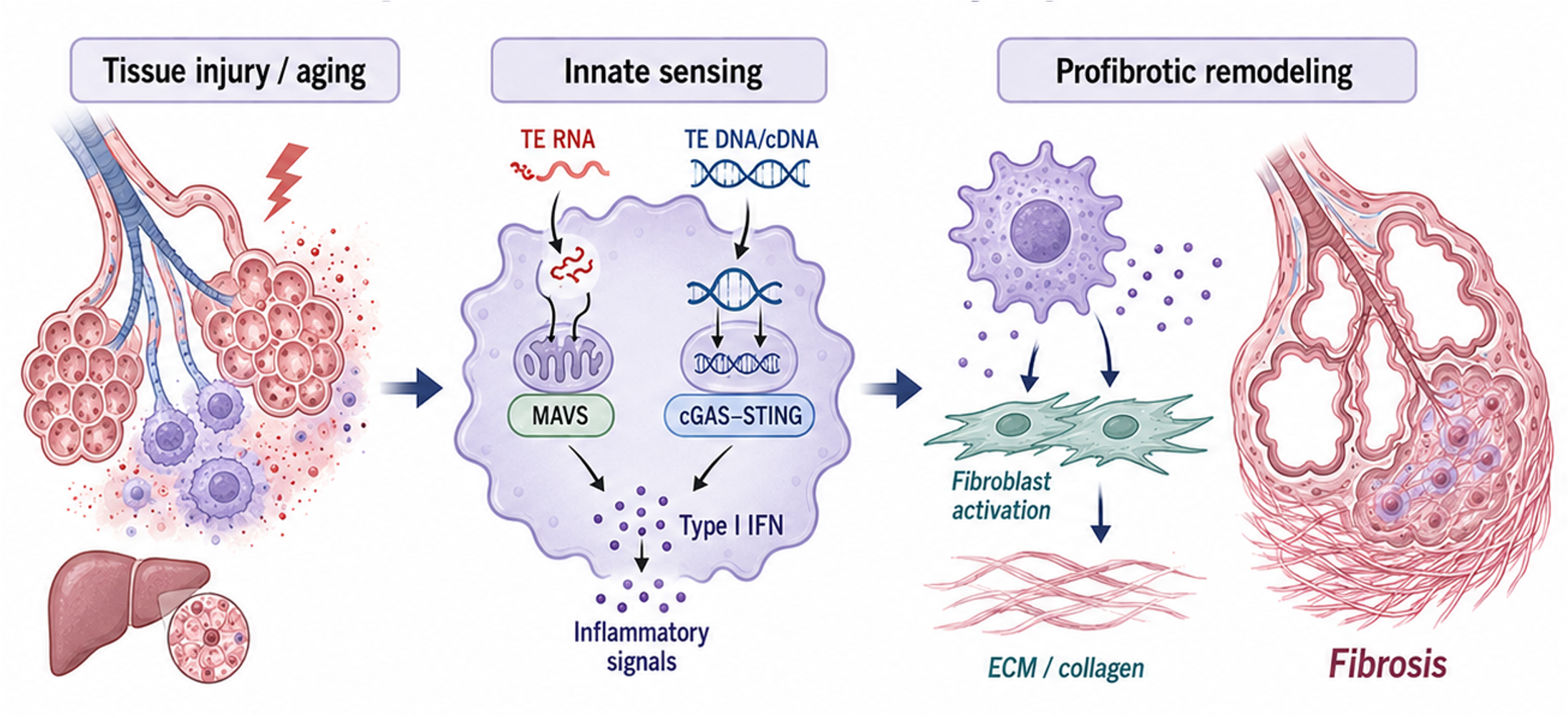
Defining how retroelement sensing contributes to fibrotic remodeling
Fibrosis is a maladaptive response to tissue injury in which persistent inflammation, fibroblast activation, and excessive extracellular-matrix deposition progressively disrupt organ structure and function. Macrophages are central to this process, coordinating early tissue repair but also adopting scar-associated states that can sustain inflammation and collagen production. Our project investigates whether retroelements—including LINEs and endogenous retroviruses—act as endogenous triggers that promote this transition from repair to pathological fibrosis.
Retroelements are normally restrained by epigenetic and post-transcriptional mechanisms. During aging, cellular stress, senescence, or tissue injury, these controls may weaken, leading to the production of immunogenic RNA and reverse-transcribed DNA intermediates. We are testing how these molecules activate innate immune pathways, particularly MAVS and cGAS–STING, and how the resulting type I interferon and inflammatory responses reshape macrophage function and fibroblast activation.
Using experimental models of lung and liver fibrosis, we aim to define when and where retroelements become activated, identify the cells that produce and sense retroelement-derived nucleic acids, and determine how these signals influence the emergence of profibrotic macrophage states. We are combining transcriptional profiling, genetic perturbation, and pharmacological inhibition to dissect the contribution of reverse transcriptase activity and nucleic acid sensing to inflammatory remodeling and extracellular-matrix deposition.
A major goal of this work is to determine whether targeting retroelement activity can interrupt fibrosis without broadly suppressing protective immunity or normal tissue repair. By defining the molecular links between retroelement activation, innate immune sensing, and scar formation, this project seeks to uncover new therapeutic strategies for age-associated and chronic fibrotic diseases.